
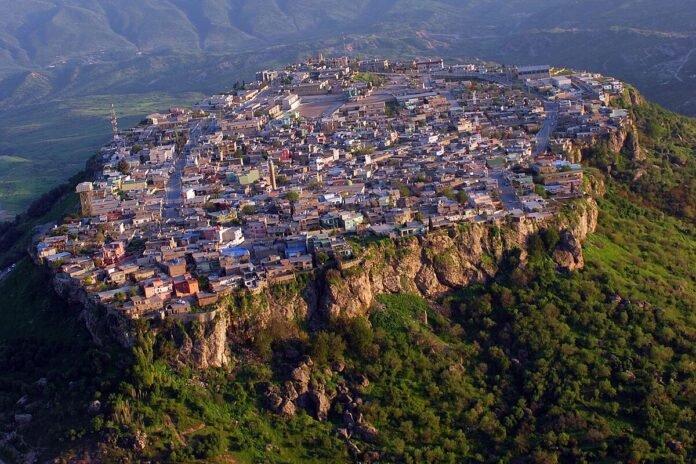
Amedi, also known as Amadiye, stands proudly in the Duhok Governorate, built atop a striking mesa in the Great Zab river valley. This historic town remains a symbol of Kurdish culture and is especially famous for its vibrant Newroz celebrations.
The name “Amedi” may trace back to Imad al-Din Zengi, who built a citadel on its ancient foundations in 1142. Another theory links the name to Imad al-Dawla, although that claim lacks solid support. However, archaeologist Jeffrey Szuchman argues the name likely has Hurrian or Urartian roots.
Amedi’s roots go deep into the Early Bronze Age. It formed part of the Kurda region and was once inhabited by Subartu, a non-Semitic people. Later, in the 16th century BC, the Mitanni Empire took control. At that time, locals were known as Zubarians.
Following the Mitanni collapse, the Assyrian ruler Ashurnasirpal I conquered Amedi in the 11th century BC. The region later came under Median rule, and Xenophon, the Greek historian, passed through its ruined Median cities in the 4th century BC. Afterward, the Achaemenid Empire incorporated Amedi as part of Media Magna. The Parthians ruled it within the Barzan district, and eventually, it became part of the Sasanian Empire in Adiabene. In the 640s, Muslim forces captured the area after defeating Kurdish forces around Tikrit, Mosul, and Sharazor.
For centuries after the Abbasid Revolution, an amir from the Abbasid family ruled Amedi. By the 12th century, the town became the birthplace of David Alroy, a messianic figure who led a failed revolt. At the time, around 1,000 Jewish families lived in Amedi, actively trading goods like gall-nuts.
From 1376 to 1843, Amedi served as the capital of the semi-autonomous Bahdinan principality. During the reign of Sultan Hussein Wali (1534–1576), the Qubahan School was established for Islamic scholarship. Remains of this school still exist, along with ruins of a synagogue, a church, and a tomb attributed to the prophet Ezekiel.
The city’s Great Mosque, dating back to the 12th century, remains one of its iconic landmarks and the largest mosque in the area.
In 1760, Dominican missionary Leopoldo Soldini founded a mission in Amedi with Maurizio Garzoni. Garzoni stayed 14 years and compiled the first Kurdish-Italian dictionary and grammar. His work earned him the title “father of Kurdology.”
By 1907, Amedi’s population was around 6,000. Among them were 2,500 Kurds, 1,900 Jews, and 1,600 Chaldean Catholic Assyrians. This mix of cultures reflects the town’s diverse and layered past.