
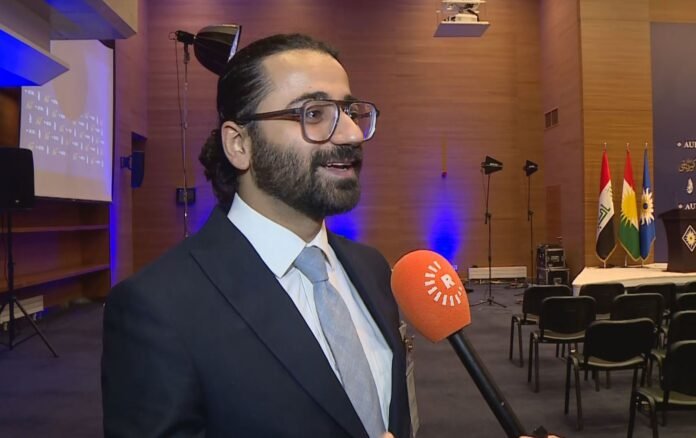
Kurdish musician Gashtyar Kawa is redefining the music scene in Iraq by blending traditional Kurdish melodies with modern synth sounds. Kawa, originally from Sulaimani, combines the microtonal heritage of Kurdish music with contemporary genres such as synthwave and electronic music. His innovative approach is attracting attention both locally and internationally.
Kawa’s songs, including Drkan, Parwanatm, Yar, and Nur, showcase this fusion. He merges traditional rhythms with synth-driven arrangements, creating a sound that is both fresh and rooted in Kurdish culture. “It is a blend. It is not absolutely modern… and it’s not absolutely traditional,” Kawa said during the Kurdish Studies Forum at the American University of Iraq, Sulaimani. The forum promotes dialogue, research, and cultural exchange on Kurdish history, literature, and the arts.
One of Kawa’s biggest challenges has been adapting Western instruments to Kurdish microtonal scales. Modern instruments are built on the twelve notes within an octave, while Kurdish music often uses intervals in between those notes. “I had to somehow customize those notes, and it was the most challenging thing for me,” he explained.
Despite these hurdles, audiences have responded positively. Kawa noted that non-Kurdish listeners could perceive and enjoy the microtonal sounds, even though they are unfamiliar with Kurdish musical traditions. This wide appreciation has encouraged him to continue experimenting and refining his style.
Kawa produces, mixes, and masters his tracks himself, and often directs his music videos. He described the work as demanding but rewarding. “The audience is very welcoming and they love what I do. This is really motivating,” he said.
Looking ahead, Kawa is preparing a ten-track album based on a new maqam, or modal system, that he invented. This scale combines elements of Kurdish and Western music, resulting in a unique musical language. His work demonstrates the potential of fusing tradition with modernity, and it highlights the richness of Kurdish culture in Iraq’s evolving music scene.
Kawa’s creative journey shows that traditional music can evolve without losing its identity, offering listeners an experience that bridges cultures and generations.