
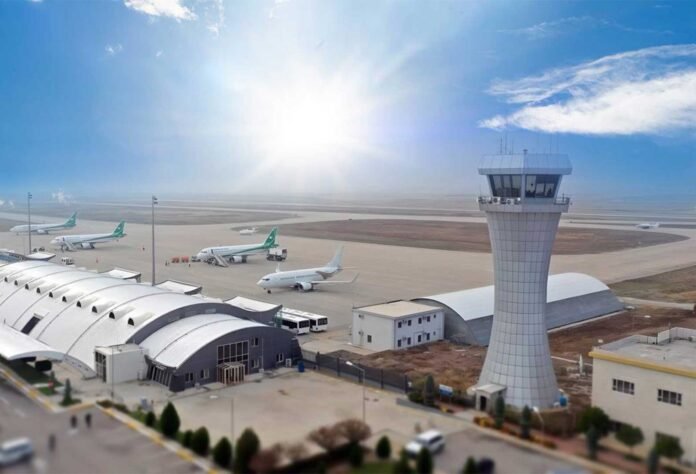
Turkey has extended the Sulaymaniyah Airport flight ban for another three months, continuing a policy that impacts the Kurdistan Region’s connectivity and economy. The Sulaymaniyah Airport flight ban reflects Ankara’s stated security concerns and ongoing political tensions with the region.
Sulaymaniyah International Airport officials confirmed that Turkey’s Civil Aviation Authority notified them of the extension. This decision delays the resumption of services until at least early January 2026. The ban closes Turkish airspace to all flights operating from or destined for Sulaymaniyah. Consequently, airlines must cancel routes or take costly detours.
Over the past two years, Kurdish officials, including Deputy Prime Minister Qubad Talabani, engaged in repeated talks with Turkish counterparts. They aimed to resolve the issue and reopen the airport. However, the discussions have not produced lasting results. Local authorities and businesses continue to face uncertainty and economic challenges due to restricted air traffic.
Turkish authorities justify the ban by claiming the airport serves as a hub for the PKK. Sulaymaniyah officials reject this assertion, insisting the airport operates as a civilian facility. In interviews, Turkey’s Consul General in the Kurdistan Region, Erman Topçu, emphasized that the measure targets security concerns, not political intentions. He stated that resolving the issue depends on Sulaymaniyah addressing Ankara’s security expectations.
Historically, Turkey has selectively used airspace closures as a political tool. Following the Kurdistan Region’s 2017 independence referendum, Ankara joined Baghdad in banning international flights to Erbil and Sulaymaniyah. When the federal government lifted the ban in 2018, Turkey resumed flights only to Erbil, keeping Sulaymaniyah suspended.
The continuation of the Sulaymaniyah Airport flight ban occurs amid broader regional peace efforts. The PKK formally ended armed struggle and dissolved its military wing earlier this year. Despite this, Turkish authorities maintain the closure, reflecting lingering distrust toward the PUK-controlled areas of the Kurdistan Region.
As the Sulaymaniyah Airport flight ban persists, it represents a critical test for Ankara-Kurdistan relations. Observers say resolving the issue could determine the durability of new reconciliation efforts. Meanwhile, the people and businesses of Sulaymaniyah remain affected by restricted international travel and economic setbacks.