
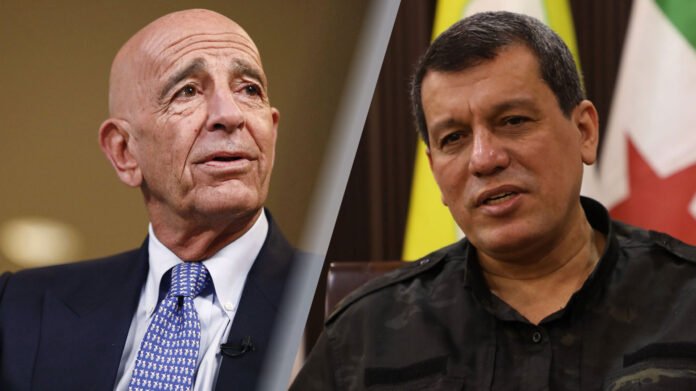
Senior political and military figures arrived in Erbil ahead of high-level discussions on Syria’s security situation. Syrian Democratic Forces commander Mazloum Abdi traveled alongside U.S. envoy to Syria Tom Barrack. Their visit comes amid renewed clashes and diplomatic efforts.
First, officials plan to discuss recent fighting in Aleppo. Violence in and around the city has raised serious concerns. Therefore, leaders aim to prevent further escalation.
Moreover, the talks will focus on reinforcing the March 10, 2025 agreement. That agreement links the Syrian Democratic Forces and the Syrian government. Both sides committed to de-escalation and coordination.
Additionally, U.S. officials want to assess the agreement’s implementation. They aim to ensure all parties respect commitments. Consequently, the visit carries strategic importance.
Meanwhile, Mazloum Abdi seeks to address security challenges affecting Kurdish and Arab communities. He has repeatedly emphasized stability and coexistence. Therefore, dialogue remains essential.
Furthermore, Tom Barrack represents Washington’s continued engagement. The United States supports political solutions and reduced violence. As a result, Barrack’s presence signals diplomatic pressure.
During the talks, participants will review developments on the ground. They will examine ceasefire violations and humanitarian concerns. In addition, they will discuss civilian protection.
Also, the meetings will address coordination mechanisms. Leaders want clearer communication channels. Therefore, they plan to improve crisis response.
Regional stability remains another priority. Instability in Syria affects neighboring regions. Consequently, officials aim to limit spillover effects.
Moreover, the delegation will discuss the role of international partners. They will explore ways to support dialogue. They will also consider monitoring arrangements.
Local officials in Erbil welcomed the visit. They emphasized Erbil’s role as a dialogue hub. Therefore, the city continues hosting sensitive negotiations.
Observers described the talks as timely. They noted rising tensions across northern Syria. As a result, diplomatic engagement gained urgency.
Furthermore, analysts expect discussions on long-term governance. Political inclusion and local administration remain key topics. Thus, future stability depends on agreements.
In addition, humanitarian access will feature prominently. Aid delivery faces obstacles in conflict zones. Therefore, leaders may seek guarantees.
The March agreement aimed to reduce confrontation. However, recent clashes tested its resilience. Consequently, reinforcement efforts matter greatly.
In conclusion, the arrival of Abdi and Barrack marks a critical moment. Talks may shape the next phase of Syrian stability efforts. Therefore, regional actors closely watch outcomes.