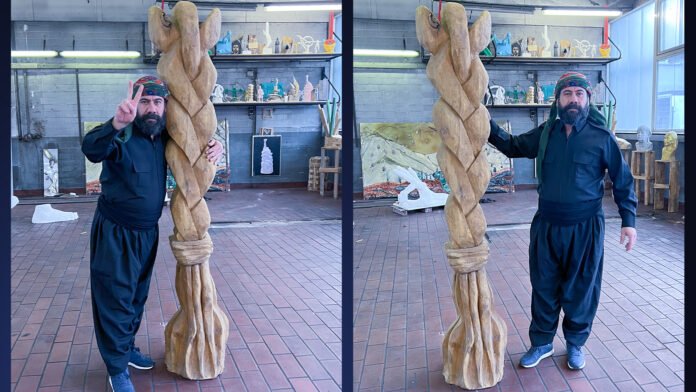
ERBIL, Iraq — Kurdish sculptor Saman Hidayat has unveiled a new artwork that pays tribute to women’s resistance and cultural identity, drawing strong public attention in the Kurdistan Region.
The sculpture features a braided form, known locally as kazi, which holds deep meaning in Kurdish society. Hidayat said the design reflects strength, continuity, and collective memory. He added that the braid symbolizes how Kurdish women preserve identity during hardship and political struggle.
During the unveiling, Hidayat explained that women have played a central role in protecting Kurdish culture across generations. He noted that the braid appears in daily life, folklore, and moments of resistance. For that reason, he chose the form as the core visual element of the sculpture.
Moreover, the artist stressed that the work speaks to both past and present struggles. He said women continue to face violence, displacement, and repression across the region. Therefore, the sculpture aims to honor endurance rather than suffering alone.
Visitors at the exhibition praised the piece for its simplicity and emotional power. Several attendees said the artwork connects cultural tradition with modern expression. Others highlighted its relevance amid ongoing debates about women’s rights in the Middle East.
Hidayat has gained recognition for blending Kurdish symbols with contemporary sculpture. In recent years, his work has appeared in exhibitions across the Kurdistan Region and abroad. He often focuses on themes of identity, memory, and resistance.
The sculpture now stands as a cultural statement that links art with social awareness. Organizers said the exhibition will remain open to the public in the coming weeks.