
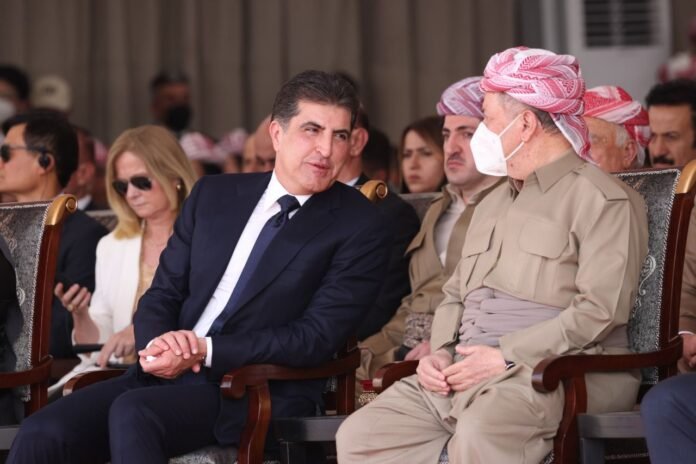
A United States report highlights the Masoud Barzani role in Rojava agreement and sheds light on new regional developments. In the first section, the report explains how the Masoud Barzani role in Rojava agreement shaped recent negotiations between the Syrian Democratic Forces and Damascus. Moreover, it details coordinated steps that aimed to reduce tensions and build trust among key actors.
According to informed sources, at least 100 non-Syrian fighters withdrew from northern Syria in recent days. They moved toward the Kurdistan Region and later reached the Qandil Mountains. Sources confirm that Kurdistan Region authorities coordinated this step. Furthermore, they describe the move as part of the January 30, 2026 agreement between the SDF and Syria’s interim government led by Ahmed al-Sharaa. The United States mediated that agreement and encouraged compromise.
Earlier, negotiators drafted a stricter framework on January 18. However, diplomatic engagement reshaped the terms. Under the revised deal, the SDF retains four military brigades. In addition, regional actors signaled cautious acceptance of the updated arrangement.
The report also stresses Nechirvan Barzani’s diplomatic engagement. On January 22, he met SDF Commander Mazloum Abdi. During that meeting, he urged the withdrawal of non-Syrian fighters to strengthen confidence. Consequently, Turkish officials welcomed the step and softened their position regarding the four brigades.
At the same time, the report underscores the Masoud Barzani role in Rojava agreement as politically decisive. It notes that he held direct discussions with Syrian officials and maintained close coordination with Kurdish leaders. Therefore, the report concludes that Kurdish unity increased despite regional uncertainty.
Most recently, leaders met again in Erbil on February 6. They reviewed implementation steps and regional stability efforts. Meanwhile, the withdrawal process continues, although officials have not released final figures.