
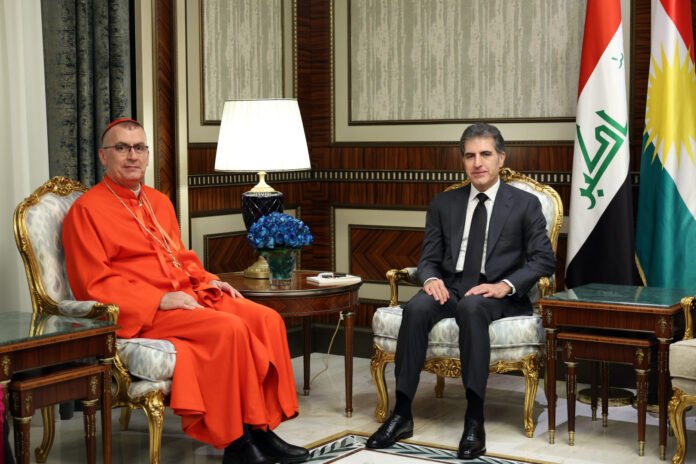
Kurdistan Region President Nechirvan Barzani received Patriarch Mar Paulus III Nona on Tuesday afternoon. Notably, the prominent religious leader heads the Chaldean Catholic Church globally. The two leaders focused their official discussions on preserving cultural coexistence. Furthermore, they emphasized the vital importance of mutual acceptance across all regional groups.
An official statement from the Presidency highlighted the main points of the high-level meeting. Specifically, President Barzani stated that Christians represent an indigenous part of the territory. He also reaffirmed his personal commitment to safeguarding their constitutional rights. Meanwhile, both figures examined the general living conditions of various local communities. They placed particular attention on the current social needs of Christian families.
The Chaldean patriarch praised the region for its inclusive social policies during the meeting. For his part, he described the territory as a safe sanctuary for all religious groups. He explicitly acknowledged Barzani’s unwavering support for ethnic minorities.
President Barzani reassured the religious leader about the region’s long-term social outlook. Consequently, he affirmed that the homeland will always protect all its diverse communities equally. He promised that the government would continue to champion cultural pluralism actively.
The territory holds a predominantly Muslim population but strongly protects freedom of religion. Historically, thousands of Iraqi Christians sought immediate shelter here during the 2014 crisis. Local churches in Ainkawa took in many displaced families before their eventual resettlement.
The Chaldean Catholic Church remains one of the oldest Eastern Catholic institutions globally. Today, significant communities thrive across North America, Europe, and Australia. The denomination faces ongoing challenges from regional instability and heavy emigration. These combined factors have dramatically reduced the total Christian population over the last few decades. Therefore, the current administration prioritizes these critical security guarantees to maintain religious diversity.