
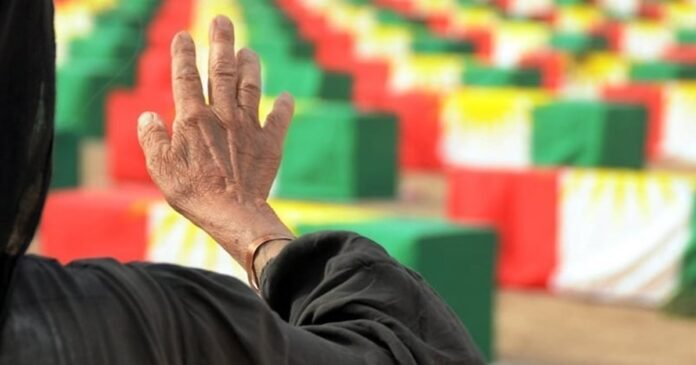
Erbil, Kurdistan Region – Kurds across Iraq marked the 38th anniversary of the Anfal campaign against the people of Garmian and Chamchamal. The commemoration on April 14, 2026, honors thousands of victims killed during one of the most brutal phases of the under the former regime of Saddam Hussein.
During the late 1980s, the regime launched systematic campaigns targeting Kurdish civilians. These operations used mass, forced displacement, and chemical attacks. The third phase of the Anfal campaign focused on Garmian and Chamchamal. As a result, entire communities faced destruction and displacement.
Thousands of civilians, including women, children, and the elderly, lost their lives. Many victims alive in remote southern deserts. Moreover, security forces destroyed villages and displaced survivors. These actions aimed to erase Kurdish identity from targeted regions.
The Anfal campaign unfolded in eight phases between 1986 and 1989. During that period, more than 180,000 Kurds disappeared or were killed. The campaign did not spare any age group or gender. Therefore, it stands as one of the darkest chapters in modern Iraqi history.
Ali Hassan al-Majid, widely known as “Chemical Ali,” led these operations. He acted under the authority of Saddam Hussein. In addition, Sultan Hashim directed military forces during the campaign. Iraqi army units and security forces carried out across Kurdistan.
Years later, Iraq’s High Tribunal addressed these crimes. On June 24, 2007, the court sentenced key perpetrators. The court handed death sentences and life imprisonment to several officials. These rulings marked a step toward justice for victims and their families.
Today, Kurdish communities continue to honor the memory of the victims. They hold commemorations and call for recognition of the campaign as genocide. Moreover, they stress the importance of preventing similar crimes in the future.
Leaders and citizens emphasize remembrance as a moral responsibility. They call for unity and justice to ensure such atrocities never happen again. Furthermore, they highlight the need to preserve historical memory for future generations.
The anniversary serves as a reminder. It also reinforces calls for accountability and human rights protection across the region.