
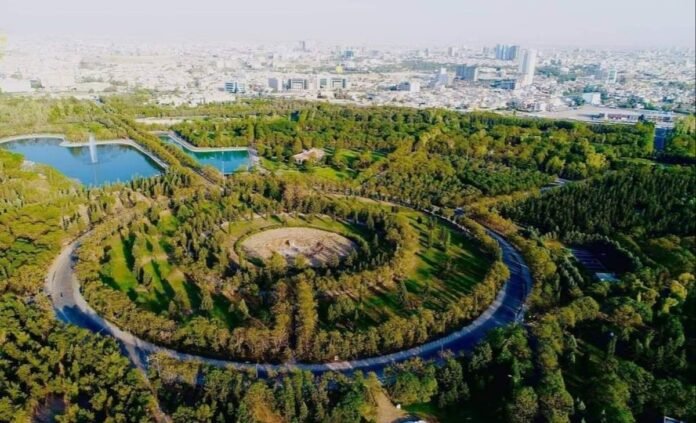
Erbil’s recycled water project transforms how the city preserves its green spaces. This innovative effort, titled Recycled Water Project, marks a major step in sustainable resource management. Located in Sami Abdulrahman Park, the project treats 800 cubic meters of wastewater daily. The treated water now irrigates the city’s largest public park instead of depleting groundwater.
Sami Abdulrahman Park, often called the “lungs of Erbil,” covers over 800 dunams. It serves as the city’s breathing space, providing much-needed greenery and fresh air. Before the new system, the park relied on 20 water wells to supply its irrigation needs. In summer, water demand can surge to 6,000 cubic meters per day.
Thanks to the Recycled Water Project, two wells have already shut down. This shift not only preserves groundwater but also reduces energy use and costs. Jamil Hussein, the park’s director, confirmed the system started operations earlier this year. “We now save money and protect vital underground water,” he noted.
Erbil faces a harsh water crisis. Climate change, population growth, and reduced river flows strain water supplies. The Recycled Water Project gives the city a new model to manage these pressures. More importantly, it offers a way forward without sacrificing public green spaces.
Sami Abdulrahman Park holds deep historical and emotional value. It was built on a former military base of the Ba’ath regime. The park honors Sami Abdulrahman, a Kurdish leader who lost his life in a 2004 terrorist attack. Today, the park not only symbolizes resilience but also leads in environmental reform.
The recycled water system pulls from Erbil’s sewer lines. It then purifies the water through an on-site facility. That water nourishes trees, lawns, and flowers across the park’s vast landscape. With fewer wells in use, groundwater levels can begin to stabilize.
This project stands as a local success. However, Jamil Hussein urges broader adoption. “The more we use treated water for irrigation,” he said, “the more groundwater we protect for future generations.” He encourages other parks, farms, and institutions to follow Erbil’s example.
The Recycled Water Project does more than conserve water. It also shows that innovation and commitment can overcome climate challenges. As cities across Iraq face similar problems, Erbil’s model offers a clear solution.
The repeated focus on the Recycled Water Project highlights its impact, purpose, and potential for replication. The initiative not only sustains Sami Abdulrahman Park but also inspires wider environmental action across the region.