
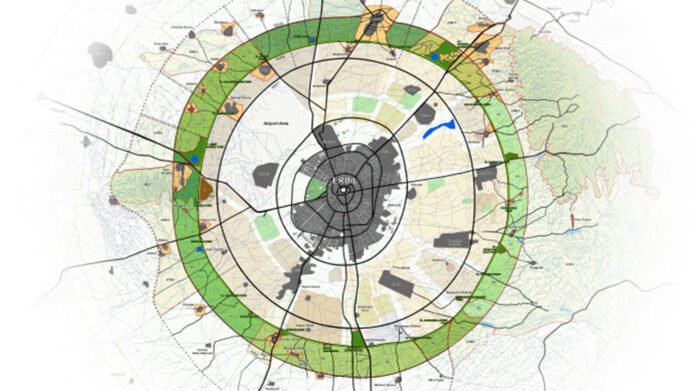
The Kurdistan Regional Government (KRG) is advancing two major forestry and clean-energy projects, positioning Erbil as a pioneer in environmental protection in Iraq. The Green Belt of Erbil and the Runaki Project together provide benefits equivalent to planting over 31 million trees.
The Green Belt of Erbil is a “visible forest” designed to protect the capital. When complete, it will stretch 92 kilometers long and two kilometers wide, with seven million fruit-bearing trees, including olives and pistachios. Covering 184 square kilometers, the forest is expected to absorb nearly 210,000 tons of carbon dioxide each year. The project also boosts agriculture, creates jobs, and improves the city’s visual appeal. “With the creation of this greenbelt, Erbil’s environment, air quality, and livability will reach a new stage,” said Governor Omed Khoshnaw. Construction is divided into zones, with work already underway in one area.
Parallel to this, the Runaki Project is creating an “invisible forest” by reducing reliance on private diesel generators. Launched in October 2024, it aims to provide 24-hour electricity to all households and businesses by 2026. Over 2.7 million people across Erbil, Sulaymaniyah, Duhok, and Halabja have benefited so far. The program has decommissioned more than 2,500 generators, cutting noise and air pollution. By project completion, more than 7,000 generators will be removed, reducing annual CO2 emissions by 600,000 tons—equivalent to planting 24 million trees.
Experts say the KRG’s dual approach—afforestation combined with emission-reduction reforms—is rare in the Middle East. While regional programs like Saudi Arabia’s Middle East Green Initiative or the UAE’s net-zero pledge are ambitious, the KRG’s efforts are uniquely practical and measurable, directly improving air quality, energy efficiency, and agricultural resilience.
Economically, the projects support local farming, diversify exports, and create jobs. Socially, cleaner energy reduces respiratory illnesses and lowers household costs. Officials describe the initiatives as “a vision for the future—one forest is visible, the other is felt through the air we breathe.”
If sustained and expanded, these projects could make the Kurdistan Region a model for balancing economic growth with ecological responsibility, showcasing resilience and progress in a region often linked to conflict.