
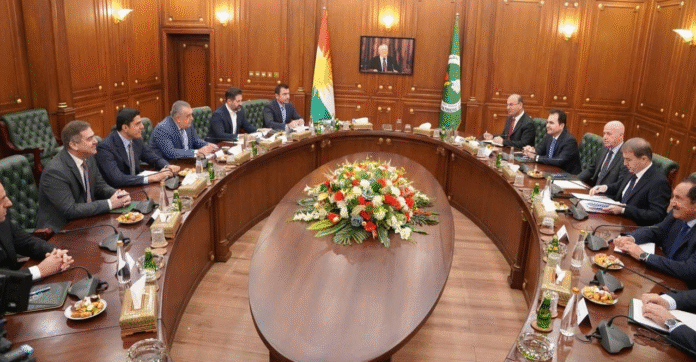
The Kurdistan Democratic Party (KDP) has warned that government formation in the Kurdistan Region could face further delays. Leaders in the party stressed that the process may not move forward until after Iraq holds its parliamentary elections.
KDP official Wafa Mohammed explained that recent talks between the KDP and the Patriotic Union of Kurdistan (PUK) produced no real progress. He noted that parliament had planned to reconvene earlier. However, regional security concerns and shifting political developments created new obstacles.
He added that some political groups now prefer linking the cabinet formation process with Baghdad’s election calendar. By doing so, they hope to strengthen their bargaining power and coordinate demands. According to him, the KDP continues to monitor the PUK’s position and decisions closely.
At the same time, Mohammed emphasized that Kurdistan currently faces no constitutional or legal vacuum. This means the delay in forming the new cabinet does not create an immediate governance crisis.
The debate over Iraq government formation continues to dominate the political scene. In April, KDP leader Masoud Barzani urged both parties to speed up the process. Yet despite his call, the region’s political deadlock has only deepened.
After the October elections in Iraq, the Kurdistan parliament entered a prolonged stalemate. Lawmakers gathered briefly in December but failed to elect a speaker or agree on a cabinet. As a result, parliament suspended sessions indefinitely, with the disputes between the KDP and PUK continuing unresolved.
The KDP argues that aligning negotiations with Baghdad’s elections could offer a stronger platform for Kurdish parties. At the same time, PUK leaders hesitate to make concessions that could reduce their leverage. This sharp political divide fuels uncertainty across the region.
Observers believe that continued tension over the Iraq government formation process may undermine trust among Kurdish parties. Furthermore, it could reduce Kurdistan’s ability to negotiate strongly with Baghdad over key issues such as oil revenues and budget entitlements.
Although leaders insist on protecting constitutional rights, citizens grow frustrated with the ongoing delays. Public employees worry about salary stability, while businesses fear uncertainty may harm investment.
For now, the focus turns to Baghdad’s upcoming elections. Many believe that once the federal parliament is seated, the path toward resolving the Iraq government formation in Kurdistan could become clearer. Yet until then, political bargaining remains intense.