
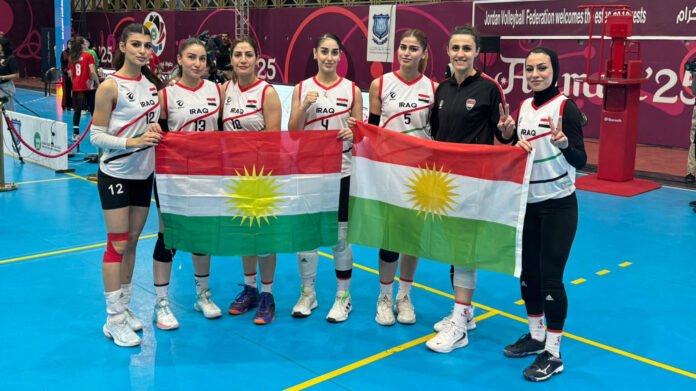
Nine Kurdish volleyball players face threats from the Iraqi Volleyball Federation after raising the Kurdistan flag following their bronze medal win at the West Asia Women’s Volleyball Championship. The federation omitted the moment from official posts, sparking criticism across Kurdish sports communities.
The incident occurred after Iraq’s women’s team, which included several Kurdish athletes, defeated Jordan to secure third place. Earlier, the team had strong matches against Saudi Arabia and Qatar but lost to Lebanon and Jordan in the semifinals.
Immediately after the final match, Kurdish athletes—overcome with pride—raised the Kurdistan flag. Federation President Habib Lawandi reportedly became furious and threatened disciplinary action against the nine players involved. The athletes—Dishni Qasim, Kajin Jalal, Bahra Hamid, Diya Walid, Helin Omar, Hamisha Wshyar, and Priva Rizgar—had played pivotal roles in securing Iraq’s podium finish.
The federation called the flag-raising a “violation of the team’s code of conduct,” while Kurdish observers described it as a natural expression of pride and identity. The athletes dedicated their victory to “all women and athletes of Kurdistan.”
Adding to tensions, the federation’s social media posts highlighted the Iraqi flag but excluded any mention of the Kurdistan flag, even as images of the celebration went viral online.
The controversy comes amid broader Kurdish athletic success. Kurdistan Region Prime Minister Masrour Barzani praised recent victories by local clubs, including Sanharib in Duhok, Akad in Ankawa, and Qaraqush/Bakhdida, reinforcing government support for sports development. Volleyball remains a popular sport among Kurdish youth, showcasing teamwork, agility, and skill.
For many, raising the Kurdistan flag symbolizes resilience, identity, and pride, especially for women athletes. Players such as Perzha Rizgar, who led Sanharib Women’s Volleyball Club to victory, have long celebrated this spirit, calling her team “the eagles of the mountains.”
The current controversy reignites debate over representation and respect for Kurdish athletes competing under Iraq’s flag while maintaining strong cultural ties. The nine athletes now stand as symbols of dual pride—representing both Iraq and Kurdistan—uniting communities even amid institutional tensions.