
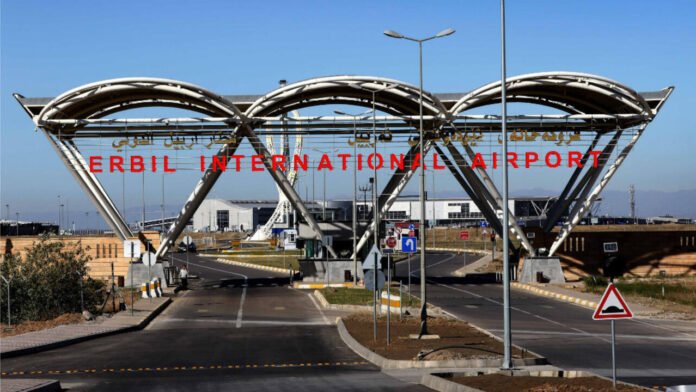
The Kurdistan Region has suffered major financial losses after a 40-day closure of its airspace. The shutdown followed the conflict involving the United States, Israel, and Iran. As a result, both international and domestic flights were suspended.
According to estimates, total losses for Kurdistan Airspace exceeded $400 million. These figures are based on flight activity from March and April 2024. During that period, more than 21,000 flights were recorded. In addition, over 2.4 million passengers traveled through the region’s airports.
Flight numbers in the Kurdistan Region usually increase each year. Since 2011, annual flights have ranged between 20,000 and 30,000. Most of these flights are international rather than domestic.
For example, in 2024, total flights reached 21,764. Of these, 17,285 were international, while 4,479 were domestic. Most flights operated through Erbil International Airport. In fact, about 83% of all flights, or 18,198, were handled there.
Airport revenues come from several sources. These include landing fees, passenger services, cargo handling, and logistics. Therefore, the suspension of flights directly reduced income for airports and airlines.
Based on estimates from the International Air Transport Association (IATA), losses during the 40-day closure reached around $416 million. This is calculated using average monthly revenues of about $386 million for airports and airlines in the region.
Passenger traffic is also significant. Each year, more than 2.5 million people travel through the region’s two main airports. In 2024 alone, around 2.4 million passengers used these airports. Most were international travelers.
Cargo transport is another key sector. At Erbil International Airport, over 19,000 tons of goods were handled in one year. Meanwhile, Sulaymaniyah Airport processed over 5,800 tons.
The airspace closure has highlighted the region’s economic dependence on aviation.