
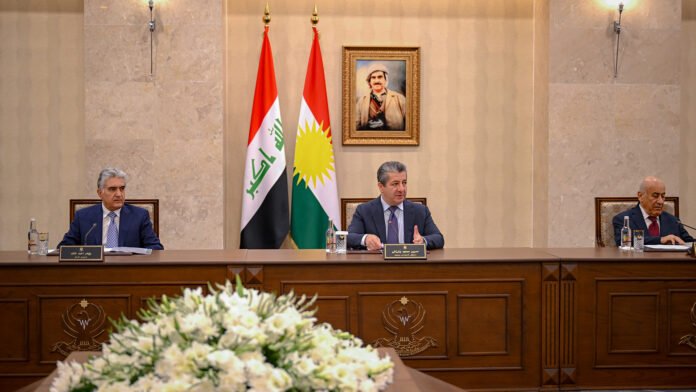
The Kurdistan Regional Government (KRG) held a meeting led by Prime Minister Masrour Barzani to review oil exports, non-oil revenues, and salary payments. The discussions reflected the region’s ongoing efforts to secure financial stability while ensuring compliance with national frameworks.
Prime Minister Barzani emphasized that the Kurdistan Region has met all its constitutional obligations. He also noted that the region showed flexibility in solving technical challenges that delayed salary payments. This approach, he explained, aims to protect public sector employees and maintain trust in government institutions.
During the meeting, Cabinet Secretary Amanj Raheem presented a report highlighting a joint proposal between the KRG and the federal government. The agreement includes handing over all oil produced in the region to Iraq’s State Organization for Marketing of Oil (SOMO), except for amounts used for local consumption. Officials expect a trilateral export agreement soon, but until then, the Kurdistan Region will transfer its oil share to the Federal Oil Ministry.
The Council instructed the Minister of Natural Resources and the negotiating delegation to carry out the decision. At the same time, the KRG reaffirmed its constitutional stance, referencing a Federal Supreme Court ruling that defines how domestic revenues are classified and distributed between Baghdad and Erbil.
Meanwhile, the Iraqi Ministry of Finance is expected to release the delayed July and August salaries for the Kurdistan Region. The Council stressed that the federal government must ensure regular and timely payments in the future. Senior officials, including Umed Sabah, President of the Diwan of Council of Ministers, and Kamal Mohammad Salih, Acting Minister of Natural Resources, also shared updates on legal and technical aspects of the negotiations.
In another agenda item, the Council discussed financial coordination with Baghdad, particularly tax policies. Members reviewed earlier talks with the Iraqi General Taxation Board and underlined the importance of stronger cooperation between federal and regional tax offices. They also affirmed that the Kurdistan Region, as a federal entity, holds constitutional rights while working to improve coordination with Baghdad.
This meeting highlighted the KRG’s dual approach: defending regional rights while maintaining collaboration with federal institutions. Oil exports, non-oil revenues, and salary payments remain at the center of the region’s economic priorities.