
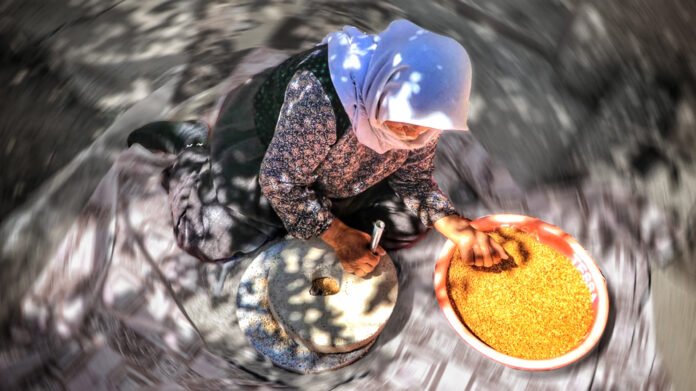
In the village of Sarnijmar, Kurdish women continue an ancient tradition by using the Destar, a hand-operated grain mill. This tool connects them to the land, sustains their families, and strengthens communal bonds.
The Destar consists of two round stones: a stationary lower stone, the binik, and a rotating upper stone, the ser. Women turn the ser by hand, grinding wheat, barley, and other grains into flour. While modern milling exists, the Destar remains central during times of food scarcity and hardship, symbolizing Kurdish resilience and self-sufficiency.
Grinding grain is not just practical; it embodies an agro-philosophical worldview. Kurdish people view seeds as sacred and the land as a provider. Wheat, in particular, represents nourishment, abundance, and spiritual blessing. Bread-making is a ritual of gratitude, linking everyday life to centuries of agricultural tradition in the Fertile Crescent.
The Destar also fosters community. Women gather in courtyards to grind together, share stories, teach younger generations, and support one another. This communal labor reinforces social ties and cultural continuity.
Historically, the region has faced famine, land disputes, and political pressures, making the act of producing one’s own flour a symbol of independence and survival.
Through the Destar, Kurdish women safeguard cultural heritage, nourish families, and maintain social cohesion. The rhythmic sound of grinding echoes the strength, knowledge, and enduring spirit of the Kurdish people, ensuring traditions persist across generations.