
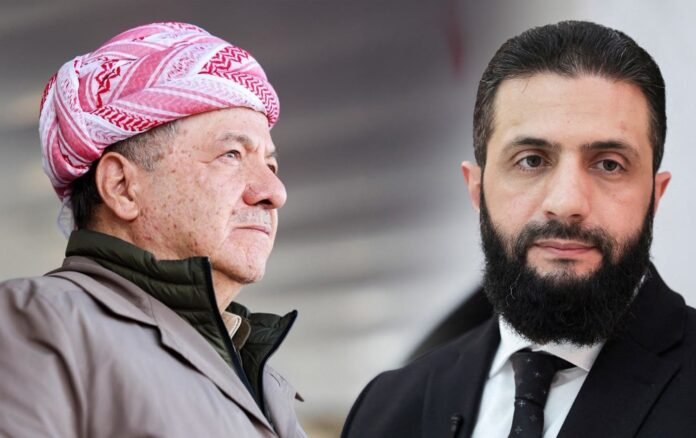
Syrian President Ahmed al-Sharaa held a direct phone call with Kurdish leader Masoud Barzani to discuss political inclusion. The conversation focused on national unity, minority rights, and future coordination. From the outset, al-Sharaa stressed recognition of Kurdish identity within Syria. He described Kurds as indigenous citizens with deep historical roots.
As a result, al-Sharaa pledged equal political, cultural, and social rights for Kurdish communities. He emphasized equality under national law for all Syrians. Moreover, he stated that diversity strengthens national cohesion and stability. He rejected exclusion and promoted shared citizenship.
In addition, al-Sharaa encouraged structured coordination between Kurdish representatives and central institutions. He argued cooperation supports security, reconstruction, and long-term development. Consequently, he framed inclusion as a strategic national priority. He also highlighted dialogue as a tool for preventing future tensions.
Meanwhile, Masoud Barzani welcomed the message and responded positively. He supported a political approach based on partnership and mutual respect. Furthermore, Barzani emphasized continuous dialogue to build trust. He urged regular communication to avoid misunderstandings and political setbacks.
During the discussion, both leaders addressed political participation in Kurdish-populated regions. They highlighted economic inclusion as a key element of stability. Additionally, they discussed joint efforts to counter regional instability. Therefore, the exchange reflected a shift toward constructive engagement.
However, regional pressures continue to challenge political progress. Still, al-Sharaa reaffirmed commitment to sovereignty alongside inclusion. He argued unity requires recognition of all communities. Similarly, Barzani stressed coordination among regional actors. He noted cooperation reduces conflict and supports economic recovery.
As a result, observers expect further talks between both sides. Communities now watch closely for practical political steps. Ultimately, the call marked a significant moment in Syria’s internal political dialogue. It signaled renewed willingness to address longstanding issues through cooperation.