
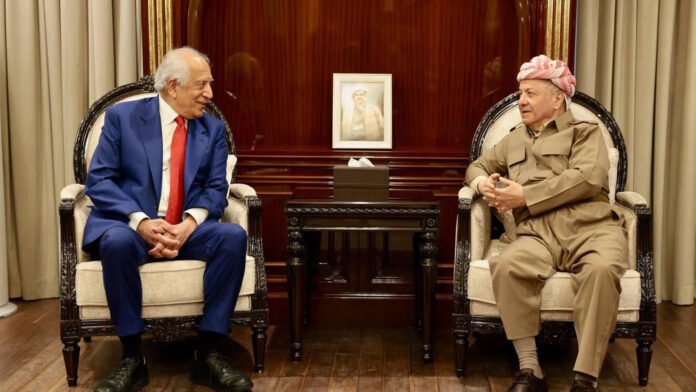
President Masoud Barzani met former United States diplomat Zalmay Khalilzad to discuss recent political developments and the changing landscape across the region. As a result, both sides exchanged views on the challenges and opportunities facing Iraq and neighboring countries.
During the meeting, President Masoud Barzani and Khalilzad reviewed the latest regional events and their potential impact on stability and security. Moreover, they examined the rapid changes taking place across the Middle East and the implications for the future. Therefore, both sides emphasized the importance of careful assessment and strategic thinking.
Regional developments dialogue remained the central focus of the discussions. In addition, the two figures addressed the risks confronting Iraq and surrounding countries as regional dynamics continue to evolve. Consequently, they highlighted the need for preparedness and constructive engagement.
President Barzani stressed the importance of maintaining stability through dialogue and cooperation. Furthermore, he emphasized that responsible leadership can help societies navigate periods of uncertainty. As a result, he encouraged efforts aimed at reducing tensions and promoting understanding.
Khalilzad also shared his views on the shifting political environment and the opportunities emerging alongside existing challenges. Moreover, he noted that regional actors must adapt to changing circumstances through coordination and pragmatic decision-making. Therefore, he underscored the value of ongoing consultation.
The regional developments dialogue also explored Iraq’s position within the broader regional context. In addition, both sides discussed how political and security developments beyond Iraq’s borders can influence domestic affairs. Consequently, they stressed the importance of maintaining awareness of wider trends.
President Barzani and Khalilzad examined the opportunities that may arise from diplomatic engagement and regional cooperation. Furthermore, they acknowledged that constructive partnerships can contribute to stability and economic progress. As a result, they expressed support for approaches based on dialogue.
The discussions reflected growing attention to the challenges facing countries across the region. Moreover, both sides recognized that rapid changes can create uncertainty while also opening new paths for cooperation. Therefore, leaders must respond with flexibility and foresight.
Observers view meetings involving experienced political figures as valuable opportunities to exchange perspectives on complex developments. In addition, such discussions can help identify areas of common interest and potential solutions. Consequently, regional developments dialogue continues to play an important role.
President Barzani and Khalilzad concluded their meeting by reaffirming the importance of consultation and cooperation in addressing future challenges. Furthermore, they emphasized the need to pursue stability through communication and mutual understanding. As a result, their talks highlighted both the risks and opportunities emerging in a changing regional environment.