
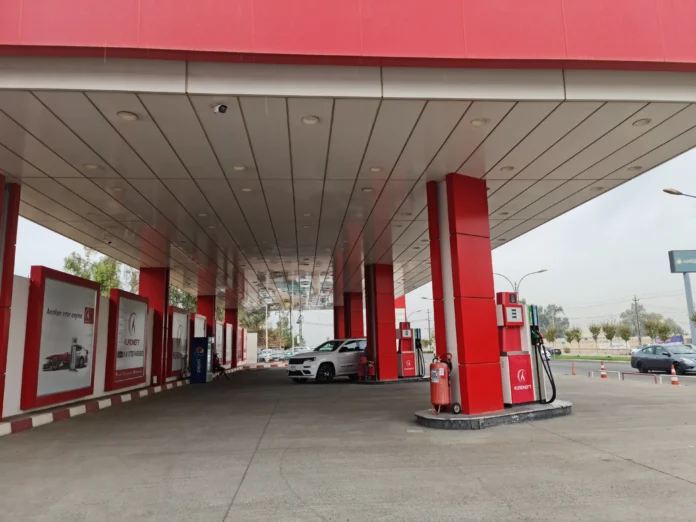
Government authorities in the Kurdistan Region introduced strict price caps for Plus and Supreme fuel on Wednesday. Prime Minister Masrour Barzani issued direct orders to address growing fuel supply shortages. Consequently, the Ministry of Natural Resources set maximum retail prices for commercial filling stations.
Gas stations may not charge more than 1,000 Iraqi dinars per liter for Plus fuel. Meanwhile, authorities capped Supreme fuel at 1,200 Iraqi dinars per liter at all filling stations. Furthermore, government suppliers will distribute regular gasoline to every operational station in Erbil.
Official regulations also require filling stations to maintain specific octane ratings for each fuel grade. Regular gasoline must have an octane rating between 89 and 92. Plus fuel must range between 92 and 95 octane. Supreme gasoline must have an octane rating between 95 and 98. Ministry officials warned that filling stations that violate these regulations will face strict legal penalties.
The new measures build on earlier price caps introduced on Monday for regular gasoline. Authorities set the price of subsidized regular fuel at 750 Iraqi dinars per liter. They also established a maximum price of 850 Iraqi dinars per liter for non-subsidized regular fuel.
Sharp increases in market prices prompted the government’s intervention. Fuel prices recently climbed to as much as 2,000 Iraqi dinars per liter in parts of the Kurdistan Region. In addition, recent drone attacks forced several international oil companies to suspend production. Reduced fuel exports further worsened local supply shortages. Energy officials also confirmed that crude oil production recently fell by 50 percent, placing additional pressure on fuel supplies.
Inspection teams continue to monitor filling stations to ensure compliance with the new regulations. Erbil Governor Omed Khoshnaw confirmed that most stations in the city quickly adjusted their prices. In addition, regional authorities plan to introduce an electronic fuel card system in the near future. Officials expect the system to improve the fair distribution of subsidized fuel to motorists.
Compliance remains lower in parts of Sulaimani and Halabja. Government inspectors will continue monitoring fuel quality and retail pricing across the region. Regional leaders hope that stricter enforcement, increased fuel allocations, and improved oversight will stabilize the local fuel market and ensure reliable supplies for consumers.