
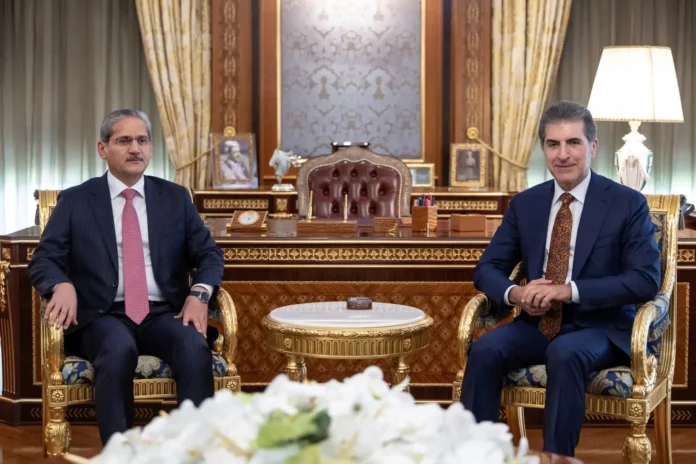
Kurdistan Region President Nechirvan Barzani received Federal Commission of Integrity Head Mohammed Ali al-Lami in Erbil on Wednesday. Both leaders discussed strengthening coordination between regional institutions and federal anti-corruption authorities in Baghdad. President Barzani pledged full cooperation to uphold judicial independence and support ongoing law enforcement measures. Meanwhile, Integrity Commission Head al-Lami expressed his appreciation for the proactive assistance already provided by regional agencies. Kurdistan Integrity Commission Head Ahmed Anwar also joined the high-level meeting to refine inter-agency operational frameworks. The dialogue comes amid Iraq’s broader anti-corruption campaign, which is targeting systemic administrative fraud.
The Erbil consultation comes amid Operation Dawn, a major federal crackdown launched by central government leaders in late June. Federal judicial bodies and specialized counterterrorism units have arrested more than 200 officials across multiple Iraqi provinces. The investigation expanded rapidly after federal officers detained former Deputy Oil Minister Adnan al-Jumaili in late May. Subsequent raids targeted high-ranking public servants, former cabinet advisers, and senior military procurement officers. Federal authorities also revoked parliamentary immunities to arrest prominent lawmakers from major legislative alliances. Consequently, oversight agencies have seized tens of millions of dollars, luxury vehicles, hundreds of properties, and more than 400 kilograms of gold.
The autonomous northern territory has already demonstrated its alignment with federal judicial warrants issued in Baghdad. Regional security forces arrested and extradited at least two wanted lawmakers to federal authorities. Regional political representatives noted that Kurdish officials remain largely unconnected to the major financial scandals uncovered so far. Nevertheless, President Barzani reaffirmed that regional authorities would fully assist judicial teams in ensuring comprehensive legal accountability. Institutional coordination can help streamline cross-border asset tracking and prevent suspects from evading federal prosecution. Furthermore, improved regulatory integration could enhance international confidence in the administrative integrity of regional economic projects.
Looking ahead, federal and regional integrity bodies plan to establish continuous monitoring protocols across public procurement sectors. Legal experts anticipate that unified judicial efforts will accelerate asset recovery operations both domestically and internationally. Moreover, joint oversight mechanisms could establish stronger institutional safeguards against future financial misconduct in major state contracts. Government leaders view greater administrative transparency as a prerequisite for long-term fiscal stability and economic modernization. Citizens across the country now expect continued judicial proceedings to recover public assets and return them to the national treasury.