
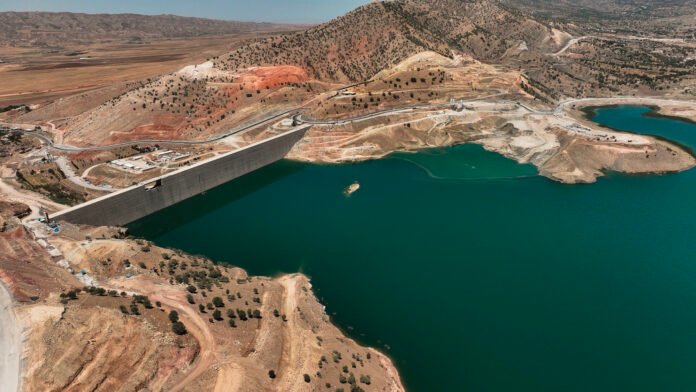
The Kurdistan Regional Government has approved a comprehensive 24-year water strategy aimed at shifting daily water consumption toward rivers and dams. Officials designed the long-term plan to significantly reduce reliance on vulnerable underground aquifers across the region.
Director-General Ari Ahmed announced that the strategy will run through 2050 and aims to secure clean water supplies for the region’s growing urban population. Under the plan, surface water resources will meet 75 percent of regional demand, while groundwater will account for the remaining 25 percent.
Currently, more than 5,000 wells extract water daily across the region to meet essential public needs. Heavy reliance on wells, combined with recurring droughts, has depleted underground aquifers in several vulnerable districts.
Under the new policy, regional authorities will increasingly draw fresh water from major rivers, including the Tigris. Engineers will also construct 26 major water treatment plants to significantly increase daily production capacity.
Existing facilities currently produce nearly 3.7 million cubic meters of water per day for residential, commercial, and agricultural use. Additional surface-water projects are expected to generate more than two million cubic meters per day to meet rising demand.
Government planners designed the extensive infrastructure expansion to support a future population of more than 11 million residents. Meanwhile, the expansion of surface-water infrastructure in Erbil has allowed local authorities to shut down nearly 1,000 wells.
Civil engineers are also constructing additional water pipelines to improve distribution networks across Sulaimani, Akre, and Chamchamal. Regional ministries have recently constructed nine large storage dams, along with dozens of smaller agricultural catchment ponds.
These structures can retain millions of cubic meters of water while helping recharge surrounding underground water reserves. Technical teams are also deploying digital monitoring systems to reduce water losses across suburban distribution networks.
A recent pilot project in Qushtapa aims to reduce pipeline leakage from 40 percent to 15 percent. However, officials acknowledge that funding constraints could delay the completion of some or all of the 26 targeted infrastructure projects.
If successfully implemented, the Kurdistan Regional Government’s water strategy could help protect valuable underground aquifers for future generations. Shifting greater reliance toward rivers and other surface-water resources would also support sustainable urban growth, environmental resilience, and long-term economic stability.