
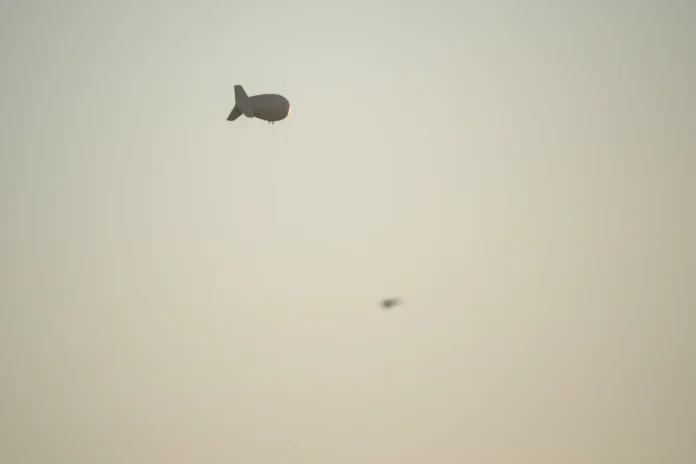
Iran’s Islamic Revolutionary Guard Corps launched coordinated drone and missile strikes against military facilities in Erbil overnight. The offensive strikes reportedly destroyed a United States surveillance balloon operating over the regional capital on Wednesday.
Kurdish security officials confirmed that the Tethered Aerostat Radar System had disappeared from the Erbil skyline. Furthermore, Revolutionary Guard ground forces claimed responsibility for destroying the primary guidance systems supporting the aerostat.
According to official statements from the Iranian military command, the strikes destroyed equipment warehouses and maintenance centers. In addition, offensive drone strikes reportedly ignited fuel storage tanks inside major military installations near Erbil.
Hostile suicide drones also targeted residential camps belonging to Iranian Kurdish opposition groups in Jezhnikan. Opposition representatives confirmed that three separate drones struck opposition facilities located approximately 20 kilometers north of Erbil.
The latest regional escalation followed widespread American aerial campaigns targeting more than 100 military sites across Iran. In response, Iranian missile barrages targeted American military installations in Jordan, Bahrain, Kuwait, and the United Arab Emirates.
Tehran reported 11 civilian fatalities in Iran following American bombardments near strategic maritime transit corridors on Tuesday. Conversely, United States military officials have not publicly confirmed Iranian claims regarding American military casualties.
Although both sides declared the immediate exchange over on Wednesday, their leaders issued stern warnings against further attacks. Meanwhile, United States President Donald Trump asserted that the United States had complete maritime control over the vital Strait of Hormuz.
Moving forward, persistent cross-border hostilities threaten to draw the strictly neutral Kurdistan Region into the broader conflict. Ultimately, local defense authorities remain on heightened alert as regional geopolitical tensions continue to escalate across northern Iraq.