
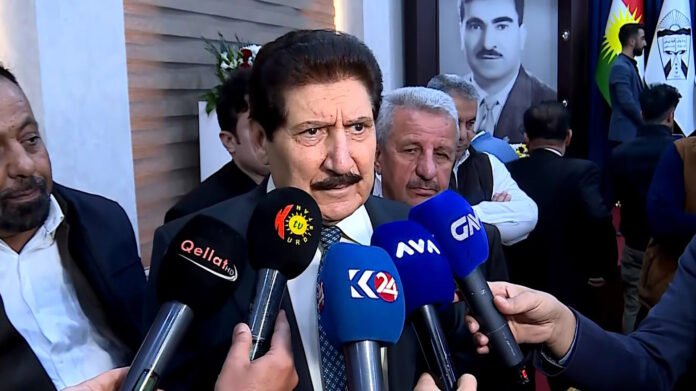
Fazil Mirani, head of the Executive Committee of the Political Bureau of the Kurdistan Democratic Party, said that most of Kurdistan’s political challenges could be resolved if political forces place the interests of the people above partisan considerations. As a result, he renewed calls for greater cooperation and national responsibility.
Mirani stated that nearly 90 percent of the Region’s political problems could find solutions through a commitment to the common good. Moreover, he stressed that political parties should focus on serving citizens rather than deepening divisions. Therefore, he urged leaders to adopt a more unified approach.
The principle of public interest first remained at the heart of his message. In addition, Mirani highlighted the importance of setting aside narrow political calculations when addressing major national issues. Consequently, he argued that many longstanding disputes could move toward resolution.
Mirani also pointed to President Masoud Barzani’s reconciliation initiative as an important opportunity for political understanding. Furthermore, he described the initiative as a sincere effort to strengthen unity and encourage dialogue among different parties. As a result, he called on all sides to engage positively with the process.
According to Mirani, Kurdistan currently faces challenges that require collective action and responsible leadership. Moreover, he emphasized that cooperation can help institutions function more effectively and respond to public expectations. Therefore, political actors should prioritize stability and progress.
The idea of public interest first also reflects broader aspirations within society. In addition, Mirani noted that citizens expect leaders to work together on issues that directly affect daily life. Consequently, he encouraged parties to place national concerns above partisan competition.
He stressed that dialogue remains the most effective tool for overcoming disagreements. Furthermore, mutual respect and openness can create an environment that supports compromise. As a result, meaningful discussions can produce lasting solutions.
Mirani argued that political maturity requires leaders to make decisions based on the welfare of the people. Moreover, he said that strengthening trust among political forces would benefit the entire Region. Therefore, he urged all parties to demonstrate flexibility and responsibility.
Observers note that appeals for unity often gain importance during periods of political uncertainty. In addition, reconciliation initiatives can help reduce tensions and build confidence among competing groups. Consequently, many continue to watch efforts aimed at promoting consensus.
The message of public interest first underscored Mirani’s belief that Kurdistan’s future depends on cooperation and shared purpose. Furthermore, he expressed hope that political parties would embrace dialogue and work together to address the Region’s challenges. As a result, he maintained that many problems remain solvable through a commitment to the national interest.