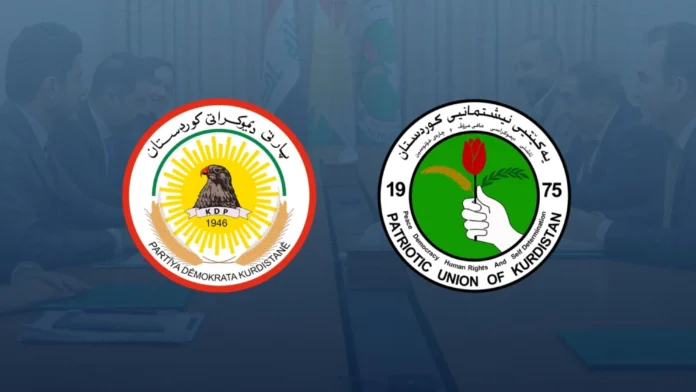
The Kurdistan Democratic Party (KDP) and Patriotic Union of Kurdistan (PUK) are expected to meet this week. The talks will focus on forming the Kurdistan Region’s next government.
Ali Hussein, a senior KDP official in Sulaimani and Halabja, announced the expected meeting Sunday. He said relations between the two parties have improved during recent months.
Hussein added that representatives from both parties held several meetings recently. Furthermore, he expects another round of talks to take place this week.
The Kurdistan Region has remained without a new cabinet since October 2024 parliamentary elections. Consequently, political parties face growing pressure to resolve disagreements and reactivate regional institutions.
The KDP won 39 parliamentary seats, making it the largest political bloc. Meanwhile, the PUK secured 23 seats, while the New Generation Movement won 15.
The PUK later formed an alliance with New Generation, creating a combined bloc of 38 seats. However, the KDP has rejected treating both parties as one negotiating group.
The New Generation Movement previously proposed forming a majority government without the PUK. However, the KDP rejected the proposal and emphasized cooperation with the PUK.
The main disagreements involve senior government positions and the structure of regional governance. As a result, political disputes have delayed cabinet formation and limited parliamentary activity.
Meanwhile, other Kurdish parties have urged the KDP and PUK to reach a compromise. Kurdistan Islamic Union Secretary-General Salahaddin Bahaaddin called for reconciliation and stronger national institutions.
The PUK also congratulated the KDP on its 80th anniversary. Additionally, it called for shared democratic and national objectives to overcome current challenges.
The KDP marked its 80th anniversary on Sunday after its establishment in 1946. The party has played a major role in Kurdish political development since its founding.
The KDP and PUK jointly formed the first Kurdistan Regional Government in 1992. Therefore, cooperation between both parties remains important for regional political stability.
KDP leader Masoud Barzani emphasized the party’s historic mission and commitment to Kurdish society. Meanwhile, Nechirvan Barzani called for modernization and stronger institutional governance.
The upcoming meeting could provide a new opportunity to resolve the prolonged political deadlock. Consequently, successful negotiations could accelerate cabinet formation and restore parliamentary activity.
For businesses and citizens, political stability remains essential for economic planning and government services. Therefore, the talks carry importance beyond the parties involved.