
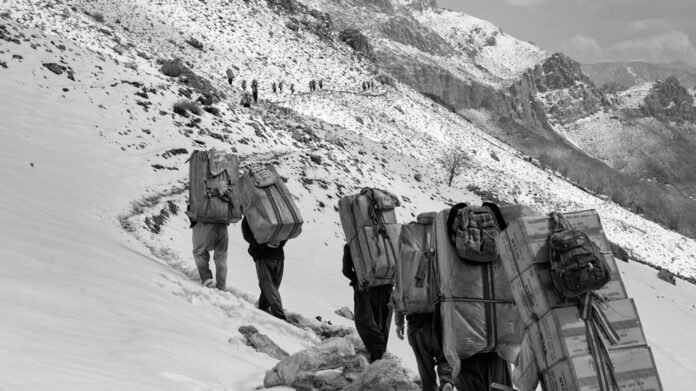
The essential Kolbari cross border trade has officially resumed at the Haji Omeran crossing after a tense three month closure. This unexpected operational restart brings immediate economic relief to thousands of vulnerable families residing in the Rojhelat border region. However, authorities have implemented strict new border regulations to manage the daily flow of laborers and goods.
The Iranian government abruptly halted all transit at this border point due to escalating regional geopolitical conflicts. This sudden shutdown completely paralyzed a formalization program that originally issued specialized trade permits to ten thousand residents. Consequently, the local economy collapsed overnight because border communities lost their primary source of sustainable income.
New administrative protocols limit daily pedestrian traffic to four hundred authorized couriers at the Haji Omeran crossing. Furthermore, individual workers can only transport a maximum weight of twelve kilograms of goods into Iran. Laborers must also present official Iranian permits and specialized identification cards before security forces allow them to pass.
Despite these rigid restrictions, the reopening has attracted workers of all age groups back to the mountain trails. Observers recently noted elderly citizens walking alongside younger men to transport household appliances, electronics, and various textiles. This diverse demographic turnout clearly underscores the absolute financial necessity of this grueling high-altitude manual labor.
Traditional couriers operating outside these regulated routes face extreme environmental perils like avalanches and hidden landmines. Additionally, independent human rights organizations frequently document severe casualties resulting from direct gunfire by border security forces. Last year alone, advocacy groups recorded dozens of courier fatalities and hundreds of severe injuries along the frontier.
State officials routinely categorize unregulated cross-border transit as illicit smuggling to justify aggressive military enforcement. Conversely, human rights advocates argue that these harsh policies disproportionately penalize economically marginalized civilians who lack employment alternatives. Moving forward, the fragile stabilization at the Haji Omeran crossing highlights the ongoing tension between national security and human survival.