
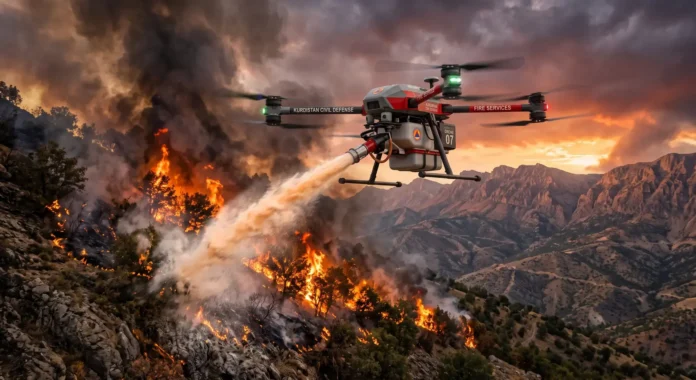
The Kurdistan Region will soon acquire specialized firefighting drones from China to combat complex structural and mountain fires. Consequently, regional emergency officials have tested the first aerial unit in Erbil while awaiting suitable weather conditions in Sulaimani.
Civil defense directorates across the Kurdistan Region requested advanced emergency equipment from the regional Ministry of Interior. Furthermore, official representatives traveled to China to complete intensive operational training on these high-altitude firefighting systems.
Severe summer wildfires frequently threaten local communities and natural ecosystems across the region’s mountainous terrain. For instance, emergency crews recently battled a massive wildfire near Sulaimani for four hours amid strong winds.
In addition, severe drought and dry seasonal vegetation fueled another significant wildfire along the slopes of Goizha Mountain. Therefore, aerial firefighting technology could help overcome physical barriers that often hinder traditional ground-based emergency response operations.
Sulaimani Civil Defense spokesperson Aram Ali confirmed that Erbil, Sulaimani, and Duhok will each receive one unit. However, strong winds over local peaks currently prevent comprehensive flight testing in the mountainous province.
Local officials are still evaluating whether these specialized drones can operate effectively in the region’s challenging mountain environments. Meanwhile, authorities plan to procure additional firefighting balloons to strengthen emergency response capabilities during later stages of the program.
Halabja Civil Defense officials said they were unaware of official plans to distribute drones to their province. Spokesperson Zanyar Omar noted that local emergency departments had submitted formal requests for modernized equipment to central ministries.
Moving forward, civil defense teams will integrate the advanced aerial equipment once weather conditions permit further flight tests. Ultimately, successful deployment could modernize emergency response infrastructure and improve firefighting operations across high-risk areas.