
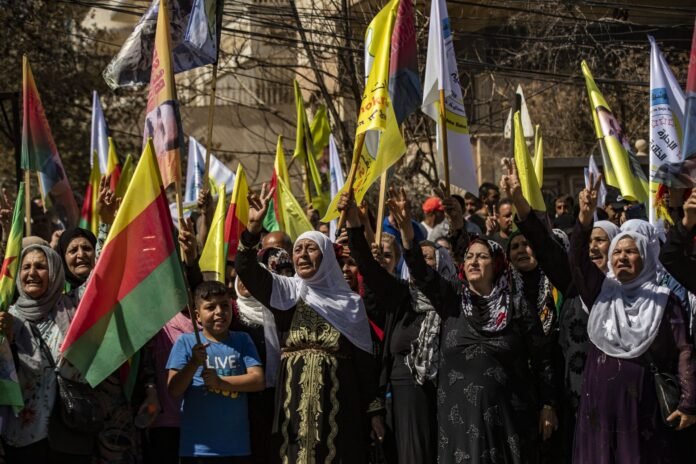
Kurds across Kurdistan and the global diaspora staged mass demonstrations. Protesters demanded immediate international intervention to stop the Syrian government’s military offensive in Kurdish-held areas of northeastern Syria.
Therefore, the Kurds protest Syria conflict has spread rapidly. Rallies took place in cities across Southern, Northern, and Western Kurdistan. Demonstrations were also held in Europe, reflecting rising fear and anger over continued attacks on Western Kurdistan, also known as Rojava.
Additionally, activists warned that the offensive could lead to mass displacement and civilian casualties. Many described the situation as a threat to Kurdish existence in the region.
Large crowds gathered in Erbil, the capital of the Kurdistan Region. Protesters marched toward the U.S. Consulate General. They waved Kurdistan flags and chanted slogans condemning oppression.
Furthermore, demonstrators voiced frustration with Washington’s response. They said the United States has influence in Syria and a moral responsibility to protect civilians in Rojava. Protesters accused international powers of silence while attacks continue.
Furthermore, similar demonstrations took place in Zakho. Protesters there expressed solidarity with Kurds across the border. Chants of “The day is our day” echoed through the streets, signaling resilience and unity.
Therefore, the Kurds protest Syria conflict also spread to Duhok, Ranya, Khanaqin, and Kalar. Participants warned against the loss of Kurdish political and social gains. They stressed that allowing violence to continue would enable the return of tyranny.
Outside the region, Kurdish communities organized protests in European cities. In Bochum, Germany, demonstrators urged European governments to pressure Damascus.
Additionally, protesters carried banners calling for protection of civilians. They warned that heavy use of tanks and artillery by the Syrian Army could trigger a humanitarian disaster. Many feared a new wave of refugees.
Therefore, the Kurds protest Syria conflict comes amid rising rhetoric from the Syrian government. On Tuesday, Syria’s Ministry of Endowments issued a directive to mosques under its control.
The order instructed clerics to recite the Takbir and lead prayers for the victory of the Syrian Arab Army. The directive cited a verse from Surah Al-Anfal and framed the military campaign as a “conquest.”
Observers said the move injected a dangerous religious element into the conflict.
At the same time, Syrian Transitional Government Information Minister Hamza Mustafa stated that Damascus would not allow the creation of a Jazira Region. He said northeastern Syria remains sovereign Syrian land.
The statement aligns with efforts to dismantle the autonomous administration that has governed the area for more than a decade.
International actors have begun limited mediation efforts. U.S. President Donald Trump reportedly spoke by phone with Syrian interim President Ahmed Sharaa on Monday.
According to sources cited by Al-Monitor, Trump urged Sharaa to halt the violence. He reportedly secured a pledge that Syrian forces would not enter Hasakah city.
A readout of the call said both leaders stressed the need to protect Kurdish rights within the Syrian state.
However, U.S. Senator Lindsey Graham warned of consequences. He said continued military operations could trigger renewed Caesar Act sanctions. Graham warned that sanctions could return “on steroids” if warnings are ignored.
Turkish President Recep Tayyip Erdogan, meanwhile, praised the Syrian Army’s operation. He described it as “carefully managed” and supported the ceasefire agreement.
Erdogan said the principle of “one state, one army” is essential for stability. He warned against delays in implementing the deal.
Despite the ceasefire announcement, violence continues. Syria’s Interior Ministry said security forces recaptured 81 ISIS militants who escaped from Shaddadi prison in Hasakah.
Around 120 inmates fled after heavy fighting damaged the facility. The Syrian Democratic Forces admitted losing control of the prison due to intense attacks and lack of support.
In northern Syria, the SDF reported clashes near Sarrin, south of Kobani. The SDF Media Center said its forces destroyed seven military vehicles and downed four drones.
The ceasefire agreement, announced Sunday, calls for integrating SDF fighters into the Syrian military. It also requires the transfer of administrative control in Raqqa and Deir ez-Zor.
Implementation remains uncertain. Fighting continues, and mistrust between parties remains high.
Kurdish leaders have issued urgent appeals. Elham Ahmad of the Autonomous Administration urged the international community to act.
She warned that silence would lead to a humanitarian catastrophe.
The Kurdish National Council in Syria also condemned attempts to impose control by force. It said military solutions would only bring more war and destruction.
As the Kurds protest Syria conflict grows, activists say international action is no longer optional. They warn that delay could cost civilian lives and destabilize the entire region.