
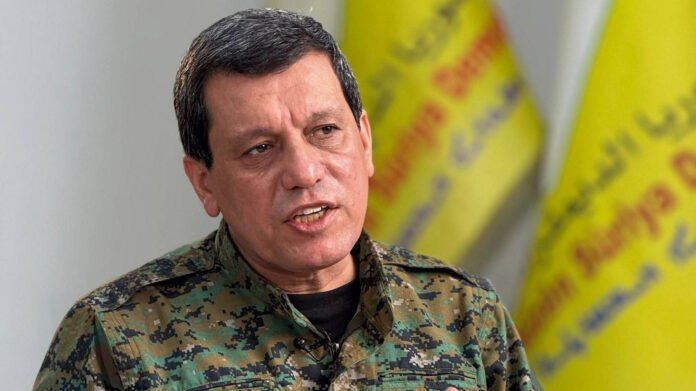
Syrian Democratic Forces General Commander Mazloum Abdi strongly condemned the recent drone attack targeting the Kurdistan Region Prime Minister’s office facilities in Pirmam. Moreover, the senior military leader described the strike as a direct assault on Kurdish institutions and regional sovereignty. Two explosive drones targeted Prime Minister Masrour Barzani’s private office and the residence of a senior security official. Fortunately, emergency responders confirmed that the late-night attack on August 17 caused no human casualties. Consequently, regional leaders view the incident as a serious provocation requiring a unified political response across the region.
According to official regional counter-terrorism reports, attackers launched two Iranian-made Hadid-110 explosive drones around midnight. Furthermore, regional security agencies reported that the drones came from across the Iranian border. Security forces immediately secured both impact sites to conduct forensic examinations and assess the structural damage. Pirmam remains an important administrative center, hosting key governmental institutions and political offices. Therefore, strikes targeting senior political officials represent a serious escalation of security threats across the Kurdistan Region.
In an official statement, Commander Abdi expressed solidarity with the Kurdistan Region government and its people. Additionally, he described the attack as an unacceptable assault on governmental institutions and regional stability. By presenting the incident as a broader security threat, Abdi highlighted growing concerns over cross-border attacks. Prime Minister Barzani also described the strike as a dangerous escalation aimed at disrupting essential government functions. Nevertheless, Barzani assured citizens that such attacks would not deter officials from carrying out their responsibilities.
The incident follows the interception of three other explosive drones over Erbil just days earlier. Consequently, repeated aerial attacks highlight vulnerabilities in local airspace monitoring and counter-drone capabilities. Security experts argue that non-state actors increasingly use relatively inexpensive unmanned systems to bypass traditional border defenses. As a result, military analysts are calling for improved counter-drone technology and stronger regional early-warning systems. Meanwhile, investigators continue examining drone debris while authorities prepare coordinated diplomatic responses to the attack.
The latest escalation has also raised concerns about wider security cooperation across the Kurdistan Region. Furthermore, regional authorities face growing pressure to protect government institutions from increasingly sophisticated aerial threats. International partners are closely monitoring developments as officials seek to prevent additional attacks. Ultimately, stronger intelligence coordination and enhanced air-defense capabilities could help reduce future risks to political and civilian infrastructure.