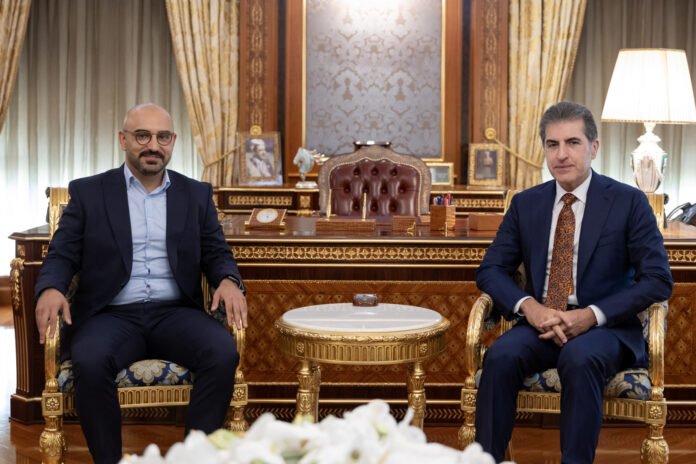
Kurdistan Region President Nechirvan Barzani hosted German parliamentarian Qasim Tahir Saleh in Erbil on Wednesday. The high-level meeting focused on strengthening bilateral cooperation in political, economic, and humanitarian fields. The two sides also discussed recent regional security developments and reaffirmed their shared commitment to regional stability. The meeting underscored Germany’s continued strategic engagement in the Middle East and its support for the Kurdistan Region.
During the discussion, President Barzani highlighted Germany’s longstanding contributions to the Kurdistan Region during critical security crises. In particular, he commended Berlin for supporting the Peshmerga forces during the war against terrorism. He also emphasized Germany’s important role in providing humanitarian assistance and asylum to displaced Yazidi survivors. Saleh acknowledged these shared efforts and expressed his commitment to maintaining strong democratic partnerships.
Since the rise of the Islamic State in 2014, Germany has been a key European partner of the Kurdistan Region and Iraq. The German military provided training and equipment to Peshmerga forces, while Berlin directed significant humanitarian assistance toward communities in the Nineveh Plains and Sinjar. These multi-year initiatives contributed to the reconstruction of damaged infrastructure and helped support vulnerable religious minority communities.
Germany’s engagement with the Kurdistan Region has also extended beyond military and humanitarian cooperation. Saleh’s political background reflects the importance of parliamentary engagement in strengthening relations between Germany and the Kurdistan Region. Both sides agreed that economic diversification and institutional reform should remain priorities for future cooperation. They also expressed support for expanding educational exchanges and green-energy investment.
The latest dialogue signals an effort to deepen institutional ties beyond security cooperation. Continued international support remains essential for thousands of displaced Yazidi and other genocide survivors who are still seeking durable solutions. Parliamentary backing in Berlin can help sustain funding for humanitarian and development programs in Iraq.
Looking ahead, further diplomatic exchanges are expected to strengthen cooperation in development, humanitarian affairs, and economic investment. Local authorities will continue to monitor joint initiatives across the Kurdistan Region. Stronger ties with Germany could also encourage greater European engagement and investment, further reinforcing the Kurdistan Region’s role as a stable and reliable regional partner.