
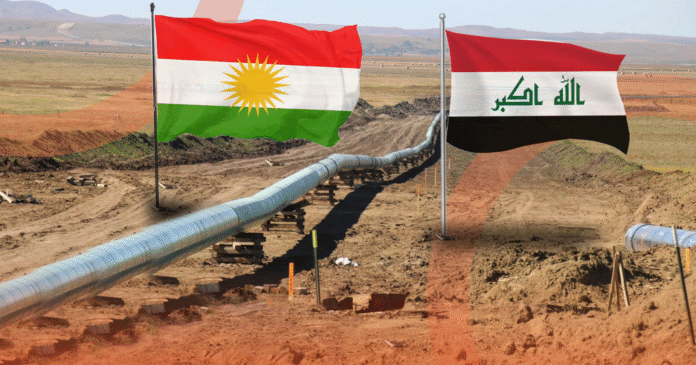
Tensions between Erbil and Baghdad have escalated again as oil negotiations hit a fresh impasse. Talks to restart Kurdish oil exports collapsed after Baghdad declined to sign a formal written deal. A source from Erbil close to the discussions confirmed that Baghdad-Erbil oil dispute continues to block progress.
The Kurdistan Regional Government (KRG) insisted on a signed agreement to formalize oil export arrangements. However, Baghdad only agreed to verbal understandings. According to the same source, Prime Minister Mohammed Shia Al-Sudani’s government fears political fallout ahead of upcoming legislative elections if a written agreement surfaces.
Negotiators from the KRG, led by Acting Natural Resources Minister Kamal Mohammed, returned to Erbil after several days of talks in Baghdad. Initial meetings appeared productive, but core issues remained unresolved. One major disagreement concerns the volume of oil to be exported through Iraq’s State Oil Marketing Organization (SOMO).
Baghdad demands that Erbil export 400,000 barrels per day (bpd), while the KRG has offered to start with 280,000 bpd. This disagreement adds to the growing Baghdad-Erbil oil dispute, which has strained relations since exports stopped over a year ago.
The halt in exports began after a Paris court ruled Turkey breached a decades-old pipeline deal. The court found Turkey allowed Kurdish oil to flow without Baghdad’s approval, violating the 1973 agreement. Since then, the Kurdistan Region has lost over $25 billion in revenue, according to KRG Prime Minister Masrour Barzani.
To address the dispute, Iraq’s parliament earlier revised the federal budget. Lawmakers introduced a $16-per-barrel fee to cover production and transport costs for international oil companies in the Kurdistan Region. They also required Baghdad and Erbil to jointly select a third-party auditor. If no consensus is reached, the Iraqi cabinet will appoint one unilaterally.
Despite these steps, the lack of a written deal still blocks oil flows. Baghdad sent a technical team to Erbil last week to discuss revenue sharing, but no breakthrough emerged. Without agreement, payments to over 1.2 million public employees in the Kurdistan Region remain suspended.
In a separate financial move, Iraq’s finance ministry recently froze all budget transfers to the KRG. The ministry accused Erbil of exceeding its federal budget allocation, a claim strongly denied by Kurdish leaders. They criticized the move as unconstitutional and politically driven, further widening the Baghdad-Erbil oil dispute.