Erbil has taken a bold step toward solving its decades-long water crisis. Prime Minister Masrour Barzani inaugurated the Clean Water for Erbil project. This launch marks a crucial moment in the city’s ongoing struggle to improve water access and quality.
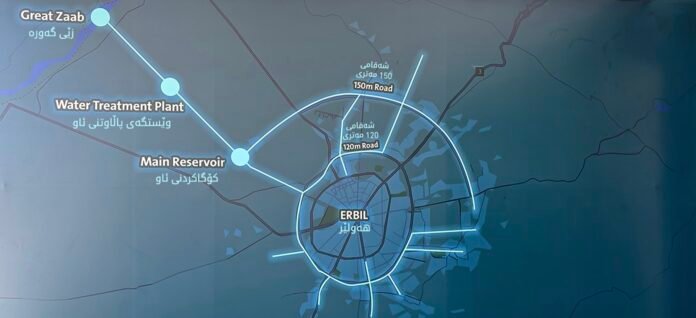
The $480 million project, funded by the Kurdistan Regional Government, will deliver clean water to over 152,000 residents in its initial phase. Sourced from the Great Zab River, the water will undergo advanced treatment before reaching homes across the city. The project began construction in July 2024 and remains on track for full completion by the end of this year.
The Clean Water for Erbil initiative aims to address water shortages that have plagued the region for years. Many neighborhoods had relied on wells, which often suffered from electricity issues or declining water levels. Now, a continuous and reliable water supply is expected to reach homes throughout Erbil.
From the village of Kawrgosk, raw river water will be sent to a high-tech treatment plant. There, it will pass through multiple purification stages to meet both World Health Organization and national water standards. Once purified, the clean water will flow through two main pipelines to a distribution facility in Seberan. This hub contains four reservoirs and a balance tank that can store up to 100,000 cubic meters of water.
Three primary pipelines will distribute this clean water into the city’s supply network. In this first operational phase, the network spans from Rashkin Road to the Mosul and Kasnazan roads, covering critical outer areas. Officials plan to expand service across the entire city soon.
Erbil Water Director Rabar Hussein emphasized the project’s 24-hour service potential. “We aim to deliver clean water to meet daily household needs,” he said. He noted the system may supply water daily or on alternate days, depending on demand and balancing efforts.
The scale of the Clean Water for Erbil project is unprecedented. It uses 200 kilometers of spiral pipes and 280 kilometers of ethylene pipes to connect Erbil’s neighborhoods. When fully completed, it will deliver 480,000 cubic meters of treated water each day—or 20,000 cubic meters per hour.
This capacity will not only end shortages but also reduce groundwater extraction. As over 1,000 wells are closed, the project will safeguard Erbil’s underground water reserves for future generations.
Immediate beneficiaries of the project include neighborhoods such as Rashkin, 32 Park, Turaq, Alan City, Diyari City, Zaytun City, and many others. Residents in these areas can now expect consistent access to safe, drinkable water.
The Clean Water for Erbil project serves both current needs and future goals. It provides a modern, eco-friendly water system while protecting critical natural resources. Most importantly, it brings hope to thousands of families who have struggled with unreliable water for years.